
What Kenosha County Property Tax Records Keep Together
Kenosha County property tax records start with Property Inquiry. The county presents it as a front end for real-estate bills, assessment, sales and building data. Its Taxes tab shows current and delinquent amounts. A visitor can view or print the record there. The assessment roll comes from each municipality's assessor. Collection splits as well: local treasurers take current-year amounts, while the County Treasurer handles prior-year delinquency. Keep the value on a tax record separate from the amount due and from any recorded sale.
| Field | What It Shows | Where |
|---|---|---|
| Assessment | Municipal value record used in the tax process | Local assessor |
| Sales and building data | Property and transfer details described by the county portal | Property Inquiry and record custodian |
| Current tax amount | Bill and payment information for the current year | Municipal treasurer or portal |
| Prior-year delinquency | Past-due amount and collection status | Kenosha County Treasurer |
| Printable tax record | View or print the tax information shown online | Property Inquiry |
An assessed value is a municipal figure kept for tax purposes. It is not the bill itself. Nor is it a promised sale price. For the full exemption list or a sample assessment card, ask the assessor what applies to the parcel and which tax year the entry covers.
Property Inquiry Opens Kenosha County Property Tax Records
Property Inquiry opens Kenosha County property tax records. A December 2024 county upgrade notice explains the guest path. A visitor signs in, searches by address or parcel, and opens Taxes. From there a user can view, print or pay current and delinquent taxes. Card payments carry a 3 percent fee and an e-check costs $1.50. Those charges apply only to online payment. Looking up or printing a record is free.
Property Inquiry also describes assessment, sale and building data. For payment questions, follow the bill and its municipality. Do not assume the county collects every current tax. The guest search begins at the Property Inquiry entry page. That page displays the access screen for county tax and parcel records.
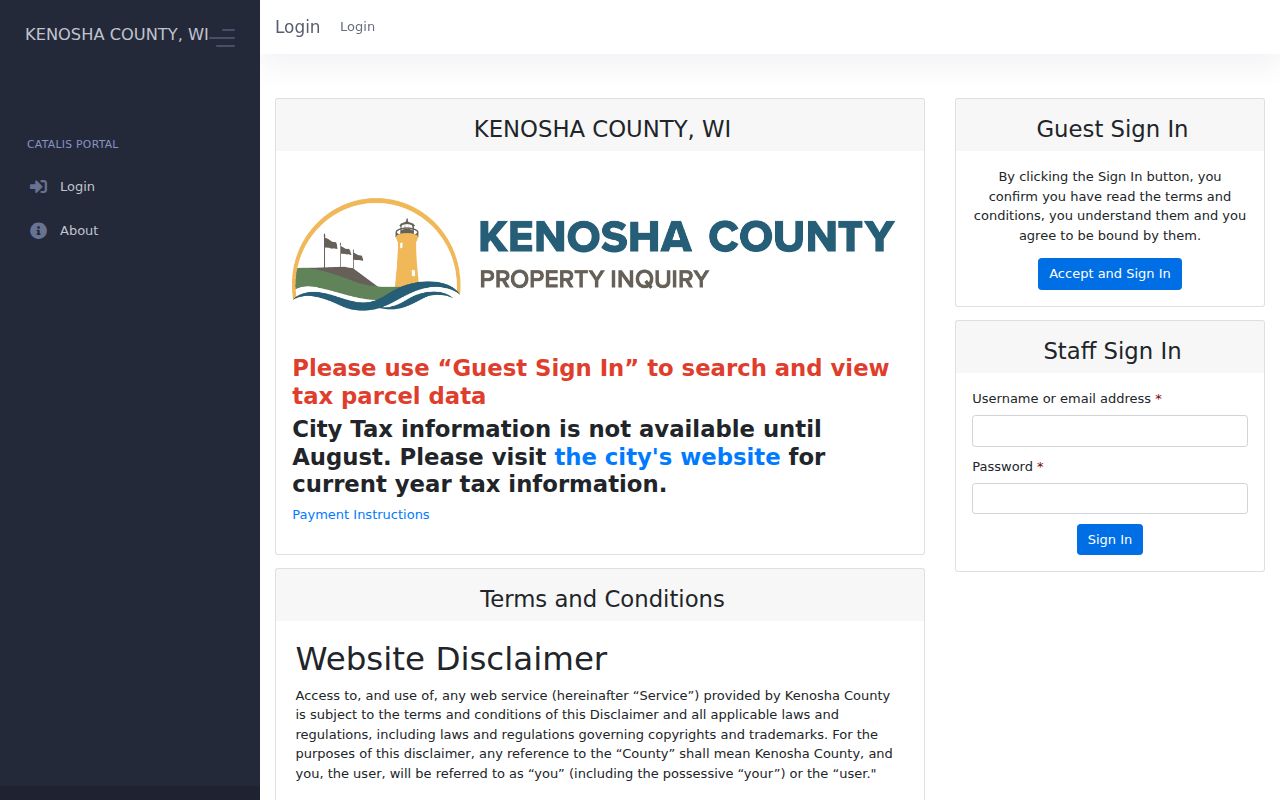
Before paying electronically, compare the amount, parcel key and tax year in the record against the notice you intend to pay. A mismatch means a wrong parcel.
Municipal Assessors Set Kenosha County Parcel Values
Assessment in Kenosha County is a municipal job. The county's assignment page names the contractors. Associated Appraisal Consultants covers Bristol, Genoa City, Paddock Lake, Paris, Somers and Wheatland. The Pleasant Prairie Assessing Consortium serves Brighton, Pleasant Prairie, Randall and Salem Lakes. The City of Kenosha runs its own office. Its assessor sits at 625 52nd Street, Room 107, phone 262-653-4480, weekdays 8:00 to 4:30.
That division matters. An address can borrow a neighboring community's name. A parcel can also sit near a boundary. Don't substitute a city card for a town roll. The county assessor assignment page shows each municipality's contact path.
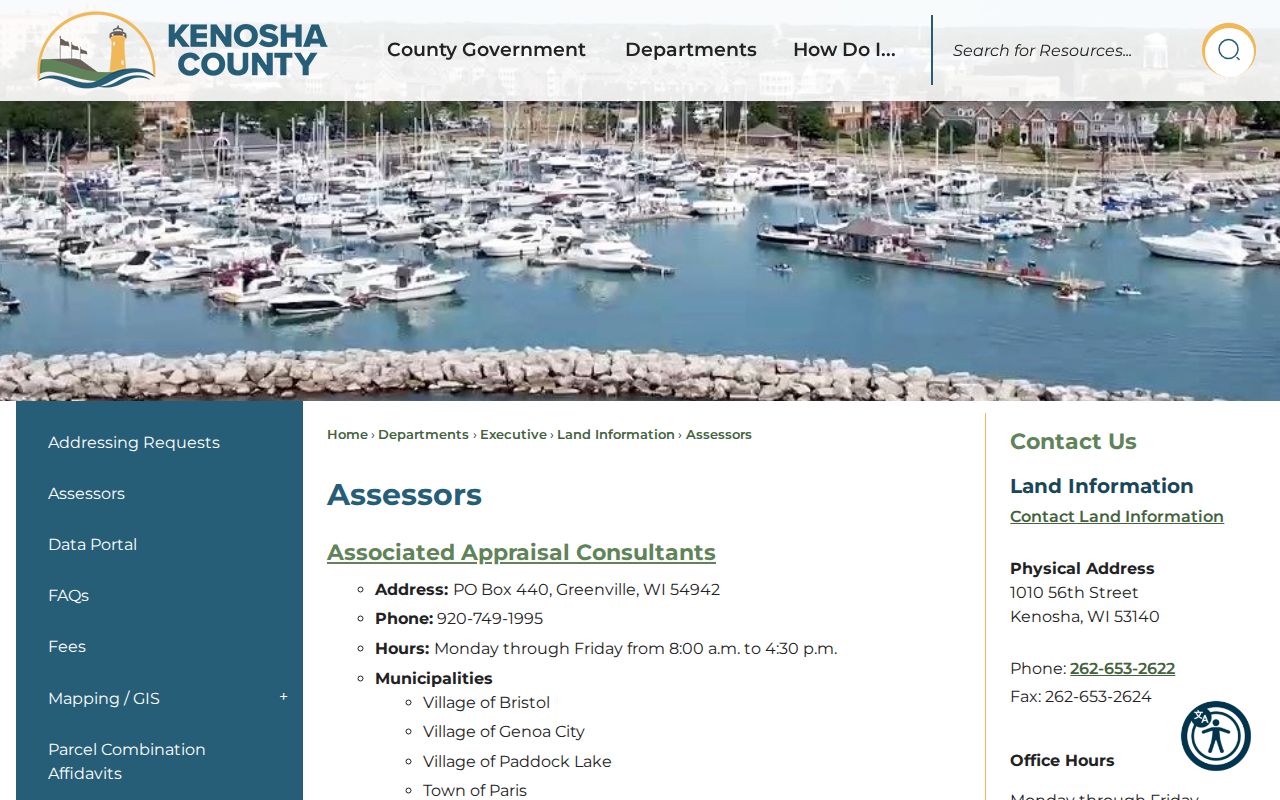
Confirm the right assessor before asking about property characteristics, a value notice or a local review meeting.
Current and Delinquent Kenosha County Taxes Route Differently
Current-year real-estate taxes in Kenosha County usually go to the municipal treasurer by January 31. Two places differ. The City of Kenosha and Pleasant Prairie run installment arrangements instead. Prior-year delinquent real-estate taxes are a county matter. The Kenosha County Treasurer collects those balances. Delinquency questions can go to 262-653-2542.
The county FAQ lists four payment routes: in person, by mail, online and by phone. For phone payment, the County Treasurer lists 1-888-891-6064, extension 2. Counter hours differ by location. Downtown hours run 8:00 a.m. to 5:00 p.m. The County Center counter closes at 4:30 p.m. Confirm current hours and accepted payment methods before a trip, especially when the bill is already delinquent and the county is the collecting office.
Start with the parcel record. It identifies the tax year and amount. The bill carries its own year, parcel and payment instructions. A current-year amount and an older delinquent balance can land with different recipients, and inconsistent payment history deserves a call to the treasurer rather than double payment through separate portals. Online surcharges are stated by the county, so compare accepted methods before submitting.
Installment terms are not uniform across the county. The City of Kenosha and Pleasant Prairie split current-year taxes into installments, while most municipal treasurers handle the current year by January 31. Never assume one due date fits every municipality. The tax bill itself names the proper recipient.
Find Kenosha County Property Tax Records by Parcel or Address
Property Inquiry lets guests search by address or parcel. An address search can return several close matches. Use the full tax key from the bill instead. The Taxes tab is the county's documented route to current and delinquent amounts, and it prints. For a street-plus-owner search, the county FAQ says Land Information staff can help locate the key using the owner spelling shown on the tax bill.
- Search Property Inquiry with the street address or complete parcel number.
- Check that the municipality, situs and tax key match the intended parcel.
- Open Taxes to view or print current and delinquent amounts.
- Route a current bill to the municipality or a prior-year delinquency to the County Treasurer.
- Assessed value
- The value entered by the assigned municipal assessor for the assessment year.
- Mill rate or levy
- A local tax rate or amount used in calculating a bill; confirm the parcel's own figures.
- Exemption
- A reduction or special treatment that must be confirmed with the assessor; the local list was not captured.
- Tax lien
- A claim tied to unpaid taxes, with status confirmed through the Treasurer and recorded or court records as applicable.
Verify Exemptions with the Kenosha County Assessor
Two county tools anchor most assessment questions. One is Property Inquiry. The other is the county Property and Taxes page. Neither displays a full exemption list or a complete sample assessment card. So do not assume any credit or exemption applies to every parcel. Ask the assigned municipal assessor instead. Find out how the exemption appears, which year it touches, and what paperwork the office requires.
The Wisconsin Department of Revenue offers statewide assessor and appeal guidance. Keep three figures straight. A taxable amount, an assessed value, and a payment due are related but distinct. When an exemption seems missing, compare the assessment record against the bill. Then call the assessor before calling it an error. Keep a copy of the notice. Note the tax year when you request a correction.
For property inside the City of Kenosha, the City Assessor sits at 625 52nd Street, Room 107. The office is reachable at 262-653-4480 on weekdays from 8:00 a.m. to 4:30 p.m. For any other municipality, use the county assessor assignment directory. It will find the office that maintains the roll. A countywide reference page cannot settle an individual parcel's exemption, review date, or local appeal calendar.
The county's assessor roster routes property questions well, but prior-year delinquency belongs to the Treasurer. If an online balance and a mailed notice disagree, give the collecting treasurer the parcel key, tax year, and payment date. For valuation concerns, describe the parcel and value year to the assigned assessor. These distinctions keep a balance question from being handled as a valuation appeal. They also keep a roll correction from landing at the wrong municipality.
Kenosha City Assessment Totals Are Not a Parcel Tax Bill
The City of Kenosha adopted budget assessment table reports real-estate assessed value of $6,978,385,100 for 2022 actual. The 2024 estimate is $8,604,472,157 across the city's real-estate categories. Those are citywide totals. They say nothing about one parcel. They cannot tell you what a lot is worth or what its owner owes. They cannot say what it might sell for.
For a single parcel, pull the municipality's assessment card and the matching tax bill. Check the assessment year and taxing jurisdiction before reading any trend into a budget figure. And leave the city number in the city. Pleasant Prairie and Somers run their own assessing arrangements, so that total does not transfer.
Check the Local Review Calendar Before Contesting a Value
Start with the Wisconsin Department of Revenue assessor guidance for statewide assessment and appeal basics. The county publishes no local appeal calendar, current deadline, or board schedule. So contact the municipal assessor named for your parcel. Ask for the notice date. Ask for the local Board of Review instructions, the filing method, and that year's evidence rules. Never borrow a general date from another municipality.
Hold on to the assessment notice, parcel key, property description, and any supporting records. A recent sale can matter. But an asking price alone does not prove an assessment error. A neighbor's tax value does not either. If the assessor points you to a formal review process, follow that office's current instructions. Keep proof that your request was received.
Local dates vary. The research did not confirm a current Kenosha County-wide appeal deadline. Verify the date and filing path with the assigned municipal assessor before relying on a calendar.